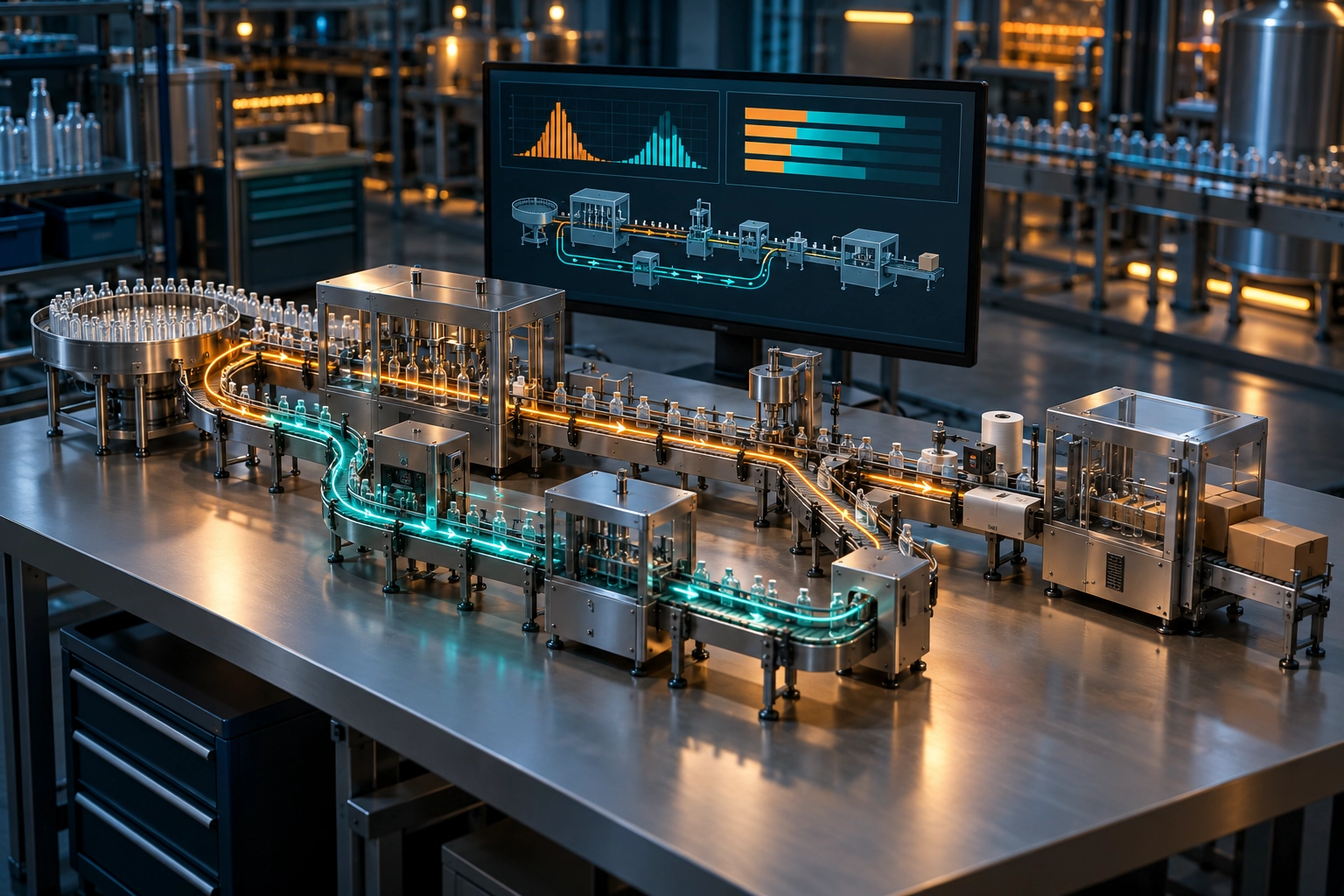

Conceptual engineering visualization · AI generated
Analytical Methods & Quantitative Decision Support · Optimization and operations research
Analytical Methods & Quantitative Decision Support
Linear and integer programming express decisions as variables, objectives and constraints. Resource allocation, production scheduling, network flow and assignment models make tradeoffs between capacity, labor, cleaning windows and utility availability explicit. Sensitivity analysis helps explain the value of relieving a constraint.
Evaluate capacity allocation and scheduling alternatives connects with define master data and scheduling rules. Connect variables and constraints to operating schedules, scenarios and human review.
Evaluate capacity allocation and scheduling alternatives connects with integrate sanitation and QA scheduling constraints. Connect variables and constraints to operating schedules, scenarios and human review.
Align production, infrastructure and workforce requirements connects with evaluate capacity allocation and scheduling alternatives. Connect forecasts and capacity evidence to option selection and measurable benefits.
Compare manual and automated work alternatives connects with evaluate capacity allocation and scheduling alternatives. Connect sampling and uncertainty to line balance and automation alternatives.
Coordinate bulk nitrogen and dosing systems connects with evaluate capacity allocation and scheduling alternatives. Connect measurement, sequencing, logistics and continuity of supply.
Coordinate chiller staging and runtime balancing connects with evaluate capacity allocation and scheduling alternatives. Connect control states and data quality to operator response and functional checks.
Coordinate projects, sites and shared resources connects with evaluate capacity allocation and scheduling alternatives. Connect resource constraints, responsibilities and decision communication across workstreams.
Define manufacturing-system needs and requirements connects with evaluate capacity allocation and scheduling alternatives. Connect master data, optimization and operating scenarios to controlled digital execution.
Design cooling loops and hydraulic balancing connects with evaluate capacity allocation and scheduling alternatives. Connect heat-transfer duty, hydraulic balance, control behavior and replacement risk.
Develop network-flow and sensitivity models connects with evaluate capacity allocation and scheduling alternatives. Connect variables and constraints to operating schedules, scenarios and human review.
Integrate ceramic filtration and automated routing connects with evaluate capacity allocation and scheduling alternatives. Connect measured process behavior, forecasts, control logic and equipment alternatives.
Integrate connected manufacturing process trains connects with evaluate capacity allocation and scheduling alternatives. Connect process architecture, scale-up, quality protection and operating readiness.
Integrate filling, packaging and conveyor equipment connects with evaluate capacity allocation and scheduling alternatives. Connect layout and integration to resource models, controls and throughput verification.
Integrate separation, concentration and final processing connects with evaluate capacity allocation and scheduling alternatives. Connect process sequence, thermal exposure, formulation requirements and product protection.
Optimize constrained resource-allocation decisions connects with evaluate capacity allocation and scheduling alternatives. Connect variables and constraints to operating schedules, scenarios and human review.
Plan compute capacity and platform requirements connects with evaluate capacity allocation and scheduling alternatives. Connect demand assumptions, architecture and turnover requirements.
Plan modular filtration growth and failover connects with evaluate capacity allocation and scheduling alternatives. Connect measured process behavior, forecasts, control logic and equipment alternatives.